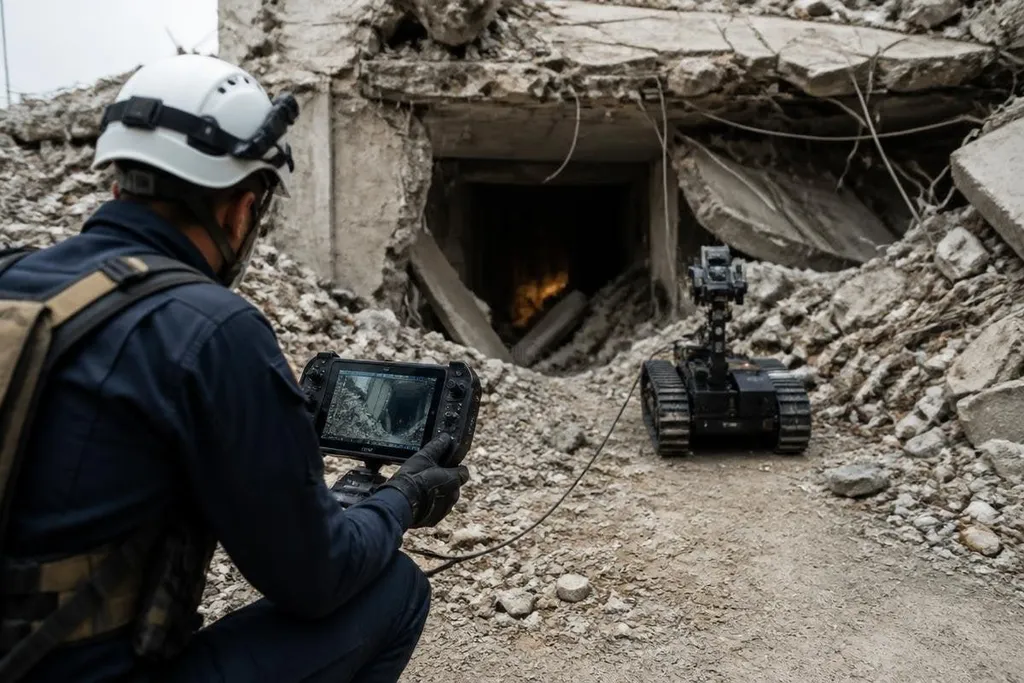
A collapsed building can hide unstable floors, gas leaks, fire, and people who need help. Disaster robots let response teams inspect those spaces before sending a person inside, using cameras, microphones, thermal sensors, and LiDAR to build a clearer view.
- Tracked robots can move through rubble and narrow passages.
- Drones can check roofs, roads, and damaged structures from above.
- Remote control keeps a trained operator away from the first danger.
Where robots fit first
The first task is usually information. A tracked ground robot can carry a video camera into a damaged building, while a thermal camera may show heat from a person or a fire behind dust and darkness.
That information helps a team decide where to search and which route is safer. The robot may also carry a microphone, gas sensor, or small arm, depending on the design. Each added tool brings more weight, power use, and training needs.
Drones cover a different part of the scene. They can look across a flood zone, inspect a roof, check a bridge, or map a blocked road without sending a crew into the area first. A drone’s view is useful only when weather, battery life, radio range, and nearby obstacles allow it to keep working.
Remote control still matters
Many disaster robots are teleoperated. That means a person sends commands while watching video and sensor data from a safe position. The robot handles movement, but the operator decides where to look and when to stop.
Some systems can follow a planned route or avoid an obstacle on their own. This is autonomy: software handles a limited part of the task, while people set the goal and deal with uncertain conditions.
That split matters in a disaster. Rubble changes as crews work, smoke can block cameras, and a route that looked safe a minute ago may become unusable.
A robot that loses its radio link needs a clear response, such as stopping, returning, or waiting for a signal.
A stop rule only helps if the report says when it fired and what the operator did next. Robot24.com robotics coverage can tie that response to the robot’s radio link, test site, and task before you judge its use in a collapsed building.
The hard parts on the ground
Reaching a dangerous space doesn't guarantee useful results. Its camera may collect poor images in dust. Its tracks may lose grip on broken concrete. Its radio signal may weaken behind thick walls, leaving the operator with a frozen view.
Power is another limit. Ground robots need enough battery for travel, sensing, lights, and radio equipment. Drones have less room for extra weight, so a larger camera or gas sensor can cut flight time.
The operator also needs practice. Driving through rubble while watching a delayed video feed takes skill, and a rescue team cannot learn that during its first live callout. Training must include lost signals, low light, blocked paths, and safe recovery when the robot gets stuck.
Data handling matters too. A map, video feed, or thermal image can guide a rescue, but only if the team can view it quickly and share it with the people making decisions. Data no one can use adds work to the scene.
A practical buying check
Before a fire department, search team, or public safety agency selects a robot, check these points:
- Target space: rubble, tunnels, flooded streets, roofs, or open ground
- Useful sensors: visible video, thermal imaging, LiDAR, audio, or gas detection
- Control link: range, wall penetration, delay, backup connection, and loss-of-signal behavior
- Working time: battery duration with the full sensor load, lights, and radio active
- Crew burden: operator training, transport case, setup time, cleaning, and repair
The right choice depends on the task. A small drone may give a fast view of a wide area, while a tracked robot may keep working after a road is blocked. A system with a gripper can move a small object, but that does not make it a machine for clearing heavy rubble.
I'd start with the sensor and control link, then choose the body that can carry them into the target space. Rescue teams need useful information first; extra movement or a larger arm comes later.
The next measure is simple: after a drill, can the team find the robot, operate it, share its data, and bring it back without adding risk? If the answer is no, the robot is still a demonstration, not a response tool.